
Author: Gift Shava

Categories Hot Tub

2026 Jacuzzi/Hot Tub Cost in Durban: Purchase, Installation and Running Costs

If you’ve been searching “Jacuzzi cost in Durban” or “hot tub prices Durban”, you’ve probably noticed the prices jump all over the place.

One ad shows a “spa” for under R20k, another quote is over R100k, and somewhere in the middle someone says, “Just budget for running costs too.”

They’re all telling the truth… they’re just talking about different types of hot tubs, with very different install requirements and electricity use.

So let’s make this simple and Durban-relevant: in this guide we’ll break your budget into the three buckets that matter most — purchase price, installation cost, and monthly running costs — and we’ll show you what pushes the number up (or keeps it sane) in Durban’s coastal climate.

Request a Custom Quote Today

Leave your details below and we’ll be in touch with a personalised quote.
Quote

The quick Durban answer: what most people pay (in real-world brackets)

In Durban, most homeowners fall into one of these brackets:

  • Inflatable / “bubble spa” style: usually the cheapest upfront, but can be expensive to run if insulation is weak. (You’ll see many options in the ±R13k–R24k range from mainstream listings.)

  • Entry-level rigid / rotational moulded tubs: you’ll see Durban suppliers quoting “from about R42k upwards” for basic rigid options. 

  • Mid-range 4–6 seater “proper” hot tubs: common pricing signals are roughly R30k–R60k (depending on brand, jets, insulation, controls). 

  • High-end built-in / luxury installs: can move into R100k–R200k+ territory (especially with premium finishes and electrical/site work). 

Now let’s unpack why those brackets happen.

What makes Jacuzzi/hot tub costs jump in Durban?

Here’s the short list of “cost drivers” I see most often when people request a Jacuzzi installation in Durban:

  • Type of tub (inflatable vs rigid vs built-in)

  • Seating size & water volume (bigger volume = more heat + more chemicals)

  • Heating method & insulation quality (this controls your monthly bill)

  • Electrical requirements (dedicated circuit, isolator, sometimes upgrades)

  • Base/foundation work (slab, deck reinforcement, leveling, drainage)

  • Coastal exposure (humidity/salt air can mean you want better hardware and covers)

  • Your usage style (daily “always warm” vs weekend “heat up when needed”)

Keep those in mind as we go through the full breakdown.

Request a Custom Quote Today

Leave your details below and we’ll be in touch with a personalised quote.
Quote

1) Purchase cost in Durban: what you’re actually paying for

Inflatable / bubble spas (lowest purchase price)

These are popular because the upfront cost feels manageable, and they’re easy to place on a level surface.

You’ll see many bubble-spa style units commonly listed in the ±R13k–R24k region depending on size/features. 

The trade-off: they’re often less insulated than rigid tubs, which can make running costs the real sting later (especially if you like hot water and you use it often).

Entry-level rigid tubs (Durban “from” pricing)

Some Durban-focused suppliers talk about basic rigid tubs starting from around R42,000+.

These generally feel sturdier than inflatables, often look better in a permanent outdoor setup, and can be more efficient depending on insulation and cover quality.

Mid-range hot tubs (the “sweet spot” for many homes)

A common national price bracket for mid-range stationary units is R30k–R60k, depending on brand and specs.

This is where you often start seeing better insulation, more reliable pumps, and controls that feel less “toy-like.”

High-end / built-in Jacuzzis

If you’re going for a true luxury “spa corner” with built-in finishes and premium features, it’s not unusual to see R100k–R200k+ price points.

At this level, the tub is only part of the spend — your site work and finishing (decking, pergola, privacy screens, electrical upgrades) becomes a big chunk of the total.

A quick note on “spa” vs “Jacuzzi”

People in Durban use hot tub, Jacuzzi, and spa interchangeably. When you’re comparing quotes, always confirm: are we quoting the tub supply only, or supply + installation, or a full built-in project?

2) Installation cost in Durban: what’s usually included

Here’s the part many people underestimate. Even if your tub is “portable,” it still needs a proper setup.

A common national reference point for installation (depending on site prep + electrical + plumbing needs) is roughly R5,000 to R20,000.

That range can be lower for a simple plug-and-play placement on a ready surface, and higher when you need electrical work, base work, or you’re doing a built-in surround.

The install items that change your quote the most

1) The base / foundation
In Durban, you want a base that stays level through rain and humidity. That usually means a proper slab, a well-built deck (rated for the load), or a prepared paved surface that won’t shift.

If you plan to place a tub on a deck, it’s worth taking weight seriously. Water is heavy — and a full tub can become a “structural project” fast.

2) Electrical work
Hot tubs draw real power. Many require a dedicated circuit, isolator, and correct protection. This is not the area to DIY or “make a plan.” Electrical scope is one of the main reasons quotes differ between installers.

3) Plumbing / drainage planning
Even if it’s not plumbed-in like a pool, you still need a sensible plan for:

  • how it fills

  • where it drains when you change water

  • how you avoid creating a soggy corner (Durban rain doesn’t forgive bad drainage)

4) Placement + coastal durability
Durban’s coastal air (especially nearer to the sea) can be rough on cheap exposed fittings over time. You’ll often get better longevity if you choose sensible placement (not directly in harsh spray zones), keep it covered, and don’t cheap out on the basics.

3) Running costs in Durban: electricity, chemicals, water, maintenance

This is the part that decides whether you love your hot tub… or resent it.

Electricity: the biggest monthly variable

A practical reference many SA sources share is that you might spend roughly R300–R1,000 per month to run a hot tub, depending on usage, electricity price, and efficiency. 

Energy use itself is often described in a wide band too — for example, about 1.5 to 4 kWh per hour depending on the unit and conditions.

And factors that push consumption up include your target temperature, jet usage, and whether the water reheats during your session.

A Durban reality check: If you use the tub often, insulation and cover quality matter more than “how many jets” for your monthly bill. Durban is warm-ish compared to inland winters, but heat loss still happens at night, and humidity doesn’t magically keep water hot.

Chemicals and water treatment

You’ll need ongoing water care products (sanitisers, test strips, balancing chemicals). These costs vary by tub size and how strict you are about water quality, but they’re always part of ownership.

Water refills

Refill frequency depends on usage and maintenance habits. The better you manage water chemistry and filtration, the less often you’ll need to drain and refill.

Maintenance and repairs

In Durban, pumps and heaters are common repair topics over time (especially if the unit runs hard, or the tub is exposed). It’s one reason many people prefer buying from a supplier that also offers servicing/repairs locally. 

Request a Custom Quote Today

Leave your details below and we’ll be in touch with a personalised quote.

Quote

How to cut running costs without killing the vibe

(Second and last bullet section — worth saving.)

  • Use a proper insulated cover and keep it on whenever you’re not using the tub (biggest win).

  • Drop the temperature slightly if you use it often (even a small drop helps).

  • Keep filters clean so the system doesn’t work harder than it should.

  • Don’t run jets longer than needed (jets are fun, but they add draw). 

  • Add wind/privacy screening if your tub is exposed (less heat loss at night).

  • Choose better insulation at purchase time (a cheaper tub can cost more long-term).

  • If you’re a heavy user, consider heating solutions that reduce element dependence — some suppliers claim big savings with solar spa heating setups (just verify suitability and real-world expectations for your exact tub).

Request a Custom Quote Today

Leave your details below and we’ll be in touch with a personalised quote.

Quote

So… is a Jacuzzi/hot tub “worth it” in Durban?

If you’re the kind of person who will use it consistently (even 2–4 times a week), many homeowners feel it’s worth it — especially in Durban where outdoor living is part of the lifestyle.

But if you only want it “for December” and you’re not into ongoing water care, a hot tub can quickly feel like an expensive garden ornament. The best way to avoid regret is to choose the right type for your habits, and be realistic about electricity and maintenance.

Quick FAQs (Durban)

Is “Jacuzzi installation Durban” usually a one-day job?

For many above-ground setups on a ready base, yes — it can be quick. Some sources note portable installs can be done in a day or two, depending on type and site readiness.

Built-in surrounds and electrical upgrades can extend timelines.

What’s the biggest mistake people make?

Underestimating the running costs and buying a tub with poor insulation because the purchase price looked good.

Can I place a hot tub on decking?

Sometimes yes — but only if the deck is designed to carry the load. If you’re unsure, treat it like a structural question, not a decor choice.

Request a Custom Quote Today

Leave your details below and we’ll be in touch with a personalised quote.

Quote
Categories Pool Construction

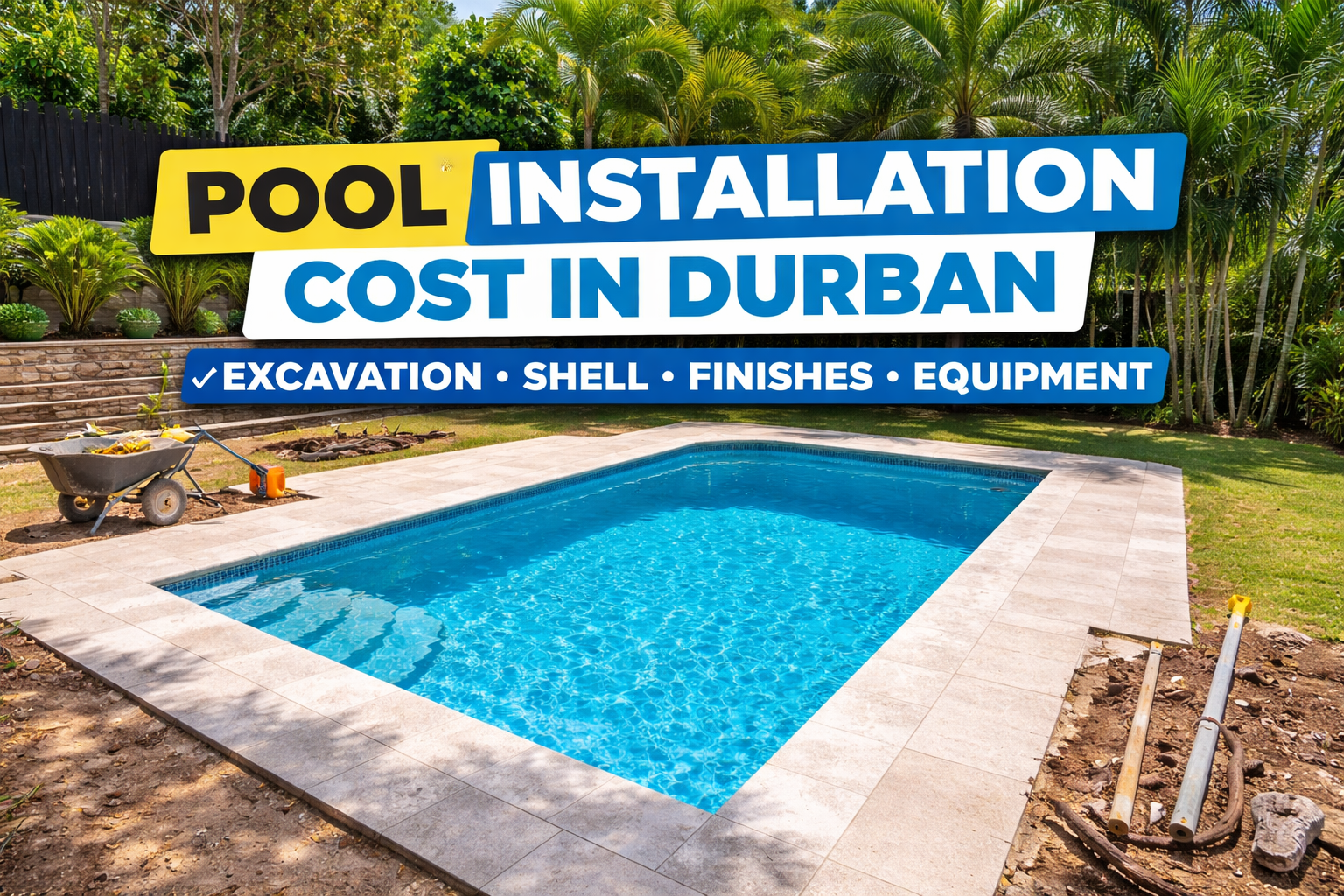
2026 Fibreglass Pool Installation Cost in Durban: Full Breakdown (Excavation, Shell, Finishes, Equipment)

If you’ve been Googling pool installation cost in Durban, you’ve probably noticed two things: the price ranges are huge, and almost every article ends with “it depends.” Which is true… but not helpful when you’re trying to budget.

Here’s the practical truth for Durban homeowners: when most people say “pool installation”, they usually mean fibreglass pool installation in Durban — a shell that gets delivered, placed, plumbed, finished, and handed over ready to use.

It’s quick, it’s neat, and it’s the type of enquiry pool builders in Durban get every day.

But even with fibreglass, quotes can vary a lot. Not because someone is trying their luck, but because your final number is built from a few cost “buckets” that change based on your property: access, excavation, base prep, shell delivery/placement, equipment, finishing level, and the surrounds that make the pool area feel premium (and survive Durban rain).

So let’s break it down properly — in the same order your project happens — so you can read a quote and instantly understand what you’re paying for.

Request a Custom Quote Today

Leave your details below and we’ll be in touch with a personalised quote.

Quote

First, what “installed” should mean (and what to confirm)

When you ask for “pool installation,” a proper quote from pool installers in Durban should be for a complete installed project, not a shell-only number.

A full installation quote typically includes:

  • excavation and soil removal

  • base preparation (what the shell sits on)

  • shell delivery + placement

  • backfilling, compaction, and levelling around the shell

  • plumbing lines + filtration equipment (pump, filter, valves, fittings)

  • electrical connection + commissioning (final setup/testing)

  • coping/edge finish (and sometimes a basic surround allowance)

If a quote looks surprisingly low, it’s usually because something big is sitting “outside” the quote (often soil removal, electrical, or surrounds).

Durban pool prices: the range people usually land in

For Durban and nearby areas (uMhlanga, Durban North, Westville, Mount Edgecombe, Hillcrest/Kloof), a standard fibreglass pool installation commonly lands somewhere in the broad region of R120,000 to R280,000 depending on access, site conditions, and finish level.

Bigger pools, premium surrounds, or tricky sites can push higher — and that’s exactly what this breakdown explains.

Request a Custom Quote Today

Leave your details below and we’ll be in touch with a personalised quote.

Quote

The real breakdown: what you’re paying for (bucket by bucket)

1) Access + excavation + soil removal (Durban’s biggest swing factor)

This is where two Durban quotes can separate quickly — before the shell is even discussed.

If your yard is flat and there’s decent side access for machinery, excavation is usually clean and predictable.

But if access is tight (narrow passage, stairs, awkward angles) or the yard is sloped, excavation becomes slower, more labour-heavy, and sometimes more complicated to remove soil from site.

In Durban specifically, rainfall makes this stage even more important. A good installer doesn’t just dig a hole — they think about levels, runoff, and where water will go when the heavy rains come.

If excavation and prep are rushed, it often shows later as puddling around the pool, washouts under paving, or a surround area that never feels “solid.”

This is why a good swimming pool contractor in Durban will ask for access photos early. Those photos often explain the cost difference better than anything else.

2) Base preparation (the part you don’t see, but you’ll feel later)

Once excavation is done, the shell needs a proper base. This isn’t a place for shortcuts.

Base prep is about creating a stable, level foundation so the shell sits correctly and stays that way.

Costs here depend on how clean the dig is, whether extra shaping is required, and how much attention is needed to get the levels perfect (especially on sloped properties).

If your quote is vague here, ask questions. Base prep is one of those “quiet” items that protects you from future headaches.

3) Shell cost + delivery + placement (the headline number — but not the whole story)

This is the part most people focus on: the fibreglass shell itself.

Your shell cost changes based on size/model (and sometimes features like step layout). But the underrated part is placement logistics.

In some Durban properties, placement is smooth. In others, it’s a puzzle: tight access, awkward routing, or limited working space.

That’s why two homeowners can choose a similar shell and still get very different totals. It’s not always the shell — it’s the property.

4) Backfilling + compaction + getting everything “locked in”

After the shell is placed, the pool needs to be backfilled and stabilised properly. This stage affects long-term neatness and durability.

Done well, the area around the pool stays firm and stable. Done poorly or rushed, you can end up with sinking edges, movement in surrounding paving, or a pool that looks fine at first but starts showing problems as seasons change.

This is also where Durban rain matters. Proper compaction and sensible drainage planning reduce the chance of the surround area getting undermined over time.

5) Plumbing + filtration equipment (this is what keeps the pool blue)

This is your pool’s “engine room,” and it’s one of the most important parts of your quote.

A typical installation includes the plumbing lines, valves, skimmer/returns, and a filtration package (pump + filter).

Your cost depends on whether equipment is standard or upgraded, how far the pump area is from the pool (longer runs cost more), and whether you’re adding systems like automation or salt chlorination.

If you’re comparing a few pool quote Durban options, watch this section carefully. Cheap equipment or under-specced filtration often turns into higher monthly costs and constant water issues.

6) Electrical + commissioning (non-negotiable)

Electrical is where professionalism shows. It should include correct power supply to the filtration area, isolation, safe connections, and commissioning — the final setup where the system is tested and handed over properly.

If you plan to add a heat pump later, it’s worth mentioning now. Even if you don’t install heating immediately, good planning can prevent rework.

7) Finishes: coping + edge detail (where it starts to look premium)

Coping is the edge finish around the pool. It’s a comfort and safety feature, but it also sets the visual “quality level” of the build.

You can keep coping clean and simple (still premium if done neatly), or you can go more high-end. Either way, coping is one of the main reasons two fibreglass installs can look completely different in the end.

8) Surrounds + drainage (the category people forget to budget for)

This is the most common Durban “surprise cost.”

People budget for the pool, then realise the pool only looks and feels finished once the surrounds are done properly.

That means paving or decking, a safe non-slip surface, and drainage planning that can handle Durban rain.

Surround costs depend mostly on square metres and finish choice. A modest surround area keeps budget under control.

A big entertainment area with premium paving/decking can add a significant amount — but it also often makes the project feel truly worth it.

Request a Custom Quote Today

Leave your details below and we’ll be in touch with a personalised quote.

Quote

What this looks like on real Durban properties

Here’s the simplest way to place yourself:

Straightforward Durban install (lower bracket):
Easy access, flat yard, standard shell, standard equipment, clean coping, and a modest surround area.

Most common Durban install (mid bracket):
Some access limitations or extra shaping, better finish level, more surround space, and a bit more drainage detail.

Complex Durban install (upper bracket):
Tight access and/or slope, heavier drainage planning, premium surrounds, longer plumbing runs, and added allowances for covers/heating/lighting upgrades.

That’s the real reason quotes vary. Most of the time, the shell isn’t the villain — it’s access, surrounds, and finish level.

Request a Custom Quote Today

Leave your details below and we’ll be in touch with a personalised quote.

Quote

Quote checklist (use this when comparing pool builders in Durban)

This is the fastest way to compare apples with apples:

  • Is excavation included — and does it include soil removal/disposal?

  • Is base prep included and clearly described?

  • Is shell delivery and placement included?

  • Does the quote include backfill + compaction (and what material)?

  • What pump and filter specs are included (brand/type/size)?

  • Are plumbing runs included (and any distance allowances)?

  • Is electrical included, and does it include commissioning?

  • What coping type is included?

  • Are surrounds included (how many m²), and is drainage included?

  • What is the timeline and what does handover include?

If a quote is missing two or three of the above, it may not be a “bad” quote — it just means you’re not seeing the full installation cost yet.

Request a Custom Quote Today

Leave your details below and we’ll be in touch with a personalised quote.

Quote

FAQs

Is “pool installation” always fibreglass in Durban?

Not always — people use the term loosely — but many enquiries do mean fibreglass installation specifically. If your quote includes shell delivery/placement, that’s typically fibreglass.

Why do quotes differ so much between pool installers in Durban?

Most differences come from access/excavation, drainage/surrounds scope, equipment spec, and whether you’re looking at shell-only vs fully installed pricing.

If I want a custom shape, is that still “installation”?

That usually becomes a longer construction project (concrete/gunite). It’s still a “new pool,” but the cost drivers and timeline differ — and it deserves its own dedicated construction pricing article.

Is there a difference between “pool builders Durban”, “pool installers Durban” and “swimming pool contractors Durban”?

People use them interchangeably, but “contractor” can imply a broader scope (project management + finishes). The best approach is to confirm what’s included — excavation, equipment, electrical, finishes, surrounds, drainage, and commissioning.

Want an accurate pool installation quote in Durban?

If you’re planning a fibreglass pool installation in Durban (or you’re still deciding), contact us. We’ll give you a clear estimate, explain what’s included, and help you compare quotes confidently — without surprises later.

Request a Custom Quote Today

Leave your details below and we’ll be in touch with a personalised quote.

Quote
Categories Pool Construction

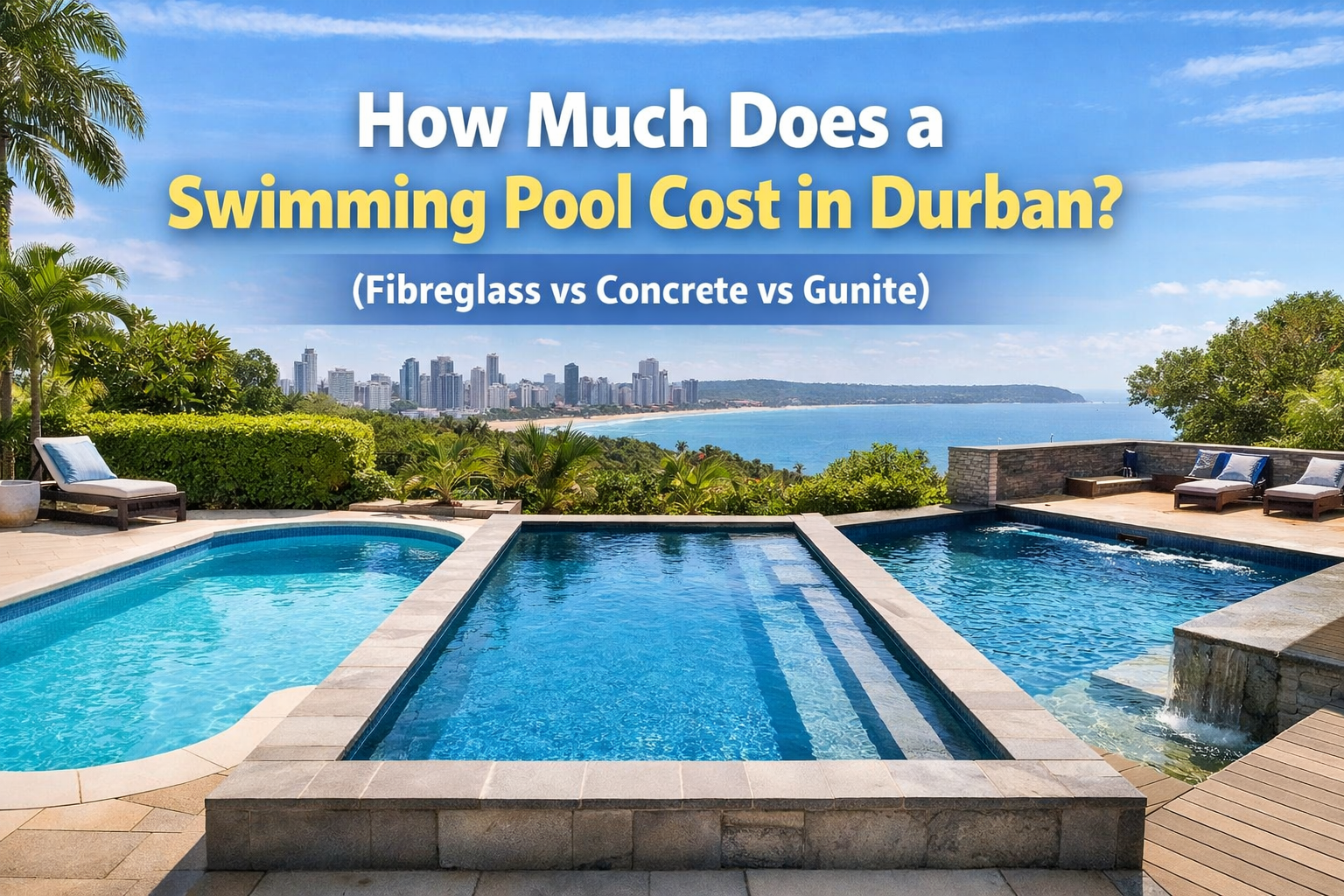
How Much Does a Swimming Pool Cost in Durban in 2026? (Fibreglass vs Concrete vs Gunite)

If you’re shopping for a swimming pool in Durban, you’ll quickly notice something confusing: two people can ask for a “standard pool,” and the quotes can still come back worlds apart.

It’s not because one contractor is being dramatic (well… sometimes), but because Durban pool pricing isn’t only about the pool type.

It’s also about site access, excavation conditions, drainage planning for heavy rain, and what you want the finished area to look like once the pool is in.

And here’s something else you’ll probably do: you’ll compare quotes from different pool builders in Durban and wonder why the numbers don’t line up when everyone seems to be offering “pool installation.”

This guide breaks down what you can realistically expect to pay for pool installation in Durban, how fibreglass compares to concrete and gunite, and what usually pushes a quote up — in plain language.

Request a Custom Quote Today

Leave your details below and we’ll be in touch with a personalised quote.

Quote

Durban swimming pool prices (realistic ranges)

These are ballpark Durban swimming pool prices for Durban and surrounding areas (uMhlanga, Durban North, Westville, Mount Edgecombe, Hillcrest/Kloof and nearby suburbs).

They vary based on access, excavation and finish level.

  • Fibreglass pool installation in Durban: ± R120,000 – R280,000

  • Concrete pool construction in Durban: ± R250,000 – R650,000

  • Gunite pool construction in Durban: ± R350,000 – R900,000+

A quick but important note: these ranges are for full swimming pool installation in Durban (a complete installed project), not “shell-only” pricing or DIY-style estimates you sometimes see online.

When people ask for “pool prices,” they usually mean the all-in result: the pool, the equipment, and a usable finished area.

Why Durban quotes vary more than you expect

Durban is a great city for pools — outdoor living is part of the lifestyle — but a few local realities show up again and again in pricing.

First, rainfall and drainage. Durban storms can dump a lot of water quickly. If your property slopes, or water naturally runs toward the pool area, you may need extra drainage planning so the area doesn’t wash out or stay muddy. This can affect excavation, backfill choices, and even the final surrounds.

Second, access. A surprising number of Durban homes have limited side access. If machinery can’t get in easily, it affects labour time, excavation logistics, and sometimes even how a fibreglass shell is positioned. This is one of the biggest reasons “pool quote Durban” numbers can differ dramatically for the same pool size.

Third, ground conditions. Some properties dig beautifully, others hit hard layers, rubble, or tricky conditions that slow excavation. That doesn’t mean you can’t build — it just means the quote may need more allowance for time and equipment.

And finally, the part people underestimate: finishes and surrounds. The pool is the centrepiece, but coping, paving/decking, and the final “clean look” around the pool often decide whether you’re building something basic or something that feels premium.

Request a Custom Quote Today

Leave your details below and we’ll be in touch with a personalised quote.

Quote

Fibreglass pool installation in Durban

Fibreglass pools are popular in Durban because installation is typically faster and the pricing can feel more predictable.

A fibreglass pool is a pre-moulded shell that’s delivered to your property, installed into the excavation, then connected to your filtration system.

What you’re paying for with fibreglass pool installation in Durban isn’t only the shell — it’s the full setup: excavation, base prep, plumbing connections, equipment, backfill, coping, and making sure the pool sits correctly and looks neat.

Fibreglass often makes sense if you want a clean, modern pool with a smooth finish, a quicker “from digging to swimming” timeline, and simpler day-to-day maintenance.

It’s also a strong choice for many “standard family pool” sizes that people ask for, like a 6m x 3m or 7m x 3.5m style pool, where the goal is a practical shape that looks great and works for everyday use.

Where fibreglass can become challenging is when the yard is extremely tight or the pool needs a very custom shape or unusual depth profile.

You can still get a premium result — it’s just that fibreglass is best when the design fits standard shell options and the site allows smooth placement.

Concrete pool construction in Durban

Concrete pools give you more design flexibility than fibreglass — shape, depth, steps, edges, benches, and how the pool integrates with your entertainment area.

In Durban, concrete is a common choice when the homeowner wants something more tailored to the property, especially if the yard has unusual angles, levels, or a specific design vision.

Concrete pool costs swing more than fibreglass because there are more variables: structure, reinforcement, labour time, finishing choices, and site factors.

A well-built concrete pool can look incredibly premium, but you should go into it knowing that some finishes may need resurfacing down the line.

That’s not a Durban-only thing — it’s simply part of owning a pool with certain plaster-type finishes over time, especially when the pool is used often.

Concrete is often the “sweet spot” when you want customisation without going fully high-end gunite.

Gunite pool construction in Durban

Gunite is generally considered the premium option for a custom pool build. It’s still a form of concrete construction, but applied in a way that supports high-end shaping and finishing.

People usually choose gunite when the pool is part of a bigger lifestyle upgrade — the full “resort look” with premium coping, detail tiling, feature lighting, and a properly designed outdoor area around it.

In Durban, gunite becomes especially appealing when the pool is being designed around the property, not simply “fit into it.”

If the goal is luxury outdoor living, gunite can be worth the premium because the finish level and design freedom are on another level.

It’s also the option you’ll often see when homeowners want unusual shapes, deeper sections, integrated seating, or a more architectural pool look.

Request a Custom Quote Today

Leave your details below and we’ll be in touch with a personalised quote.

Quote

The real cost drivers (what makes your quote jump)

This is the part that explains why one Durban quote is R180k and another is R420k for something that looks “similar” on paper.

In most cases, the big drivers are access, excavation complexity, drainage/retaining requirements, how far the pool is from the pump area (long pipe runs add cost), the finish level you choose (coping and tile details add up), and the surrounding scope (paving/decking can be a significant part of the total).

Then there are the extras people love — heating, covers, automation, upgraded lighting, water features, salt systems — which can push the overall budget higher depending on what you choose.

Here’s a practical way to think about it: a modest pool with premium surrounds can cost more than a premium pool with basic surrounds. The finished look is often where budgets climb.

“Hidden” costs people forget (and then feel the pain)

Owning a pool has ongoing costs. They don’t have to be scary — but they should be budgeted so the pool stays enjoyable instead of becoming “that thing that constantly needs fixing.”

Most Durban homeowners should plan for:

  • Electricity (mainly your pool pump run time, plus heating if installed)

  • Chemicals (rain and heavy use can shift water balance faster at times)

  • Water top-ups (evaporation, splash-out, backwashing — and after storms you may need to rebalance water)

If you want to keep monthly costs sensible, the biggest wins usually come from choosing the right pump/filtration setup, keeping water chemistry stable (so you aren’t constantly “rescuing” the pool), and using a pool cover when it makes sense — especially if the pool is exposed to debris or you want better heat retention.

Request a Custom Quote Today

Leave your details below and we’ll be in touch with a personalised quote.

Quote

Which pool type is best for Durban?

There isn’t one best option — but there is usually a best fit.

Fibreglass tends to be the best match when you want speed, neat results, and a predictable choice of shapes and sizes.

Concrete tends to win when you want flexibility and a pool that suits your yard properly. Gunite is best when you want a premium custom build and the pool is meant to be a major feature of the outdoor space.

If you’re unsure, don’t start by choosing the type. Start by choosing the outcome:

Are you building for family weekends and low stress? Are you building for entertaining and design? Are you building a luxury outdoor space where the pool is the centrepiece? Once you answer that, the right type becomes much clearer.

How to get an accurate pool quote in Durban (without wasting time)

The easiest way to get a quote that doesn’t keep changing is to be clear about three things early: your finish level (basic vs mid vs premium), your access realities (side passage width, slope, machinery entry), and your must-have extras (covers, heating, lighting, paving/decking).

If you want a meaningful estimate quickly, share your suburb and a few photos of the yard and access points. In Durban, those photos alone often explain half of the quote difference before anyone even talks about pool type.

Request a Custom Quote Today

Leave your details below and we’ll be in touch with a personalised quote.

Quote

FAQs

Is fibreglass always cheaper than concrete in Durban?

Often, yes — but not always. Tight access, premium surrounds, or a higher-end shell can narrow the gap.

On the other side, a small concrete pool with a straightforward finish and easy access can sometimes come in closer to fibreglass than people expect.

What’s the biggest “surprise cost” for Durban homeowners?

Usually surrounds and drainage. People budget for the pool, then realise paving/decking and storm-water management can be a major part of the final project — especially on sloped properties or where water naturally runs toward the pool area.

Can I build a pool in Durban if my yard is small?

In many cases, yes. A well-designed smaller pool can look more premium than an oversized pool squeezed into the wrong space. Sizes like a 6m x 3m or a compact plunge-style pool can work brilliantly if the layout is planned properly.

Are gunite pools worth it?

They’re worth it when you truly want a custom luxury build with premium finishes and design freedom, especially when the pool is part of a bigger outdoor entertainment upgrade.

“pool installers Durban” or “swimming pool contractors Durban” — what’s the difference?

People use both terms to mean similar things, but in practice: pool installers in Durban often implies a team focused on the installation/build side, while swimming pool contractors in Durban can suggest a broader scope that may include project management, finishes, and related outdoor work.

The best approach is to look past the label and confirm what’s included: excavation, plumbing, equipment, coping/surrounds, drainage allowances, commissioning, and aftercare.

Want a Durban pool quote that’s actually accurate?

If you’re in Durban or surrounding areas (uMhlanga, Durban North, Westville, Mount Edgecombe, Hillcrest/Kloof and nearby suburbs) and want a realistic estimate, Premium Pools can help.

Tell us your suburb and whether you’re leaning toward fibreglass installation, concrete, or gunite, and we’ll guide you to the right next step and quote clearly.

Request a Custom Quote Today

Leave your details below and we’ll be in touch with a personalised quote.

Quote