
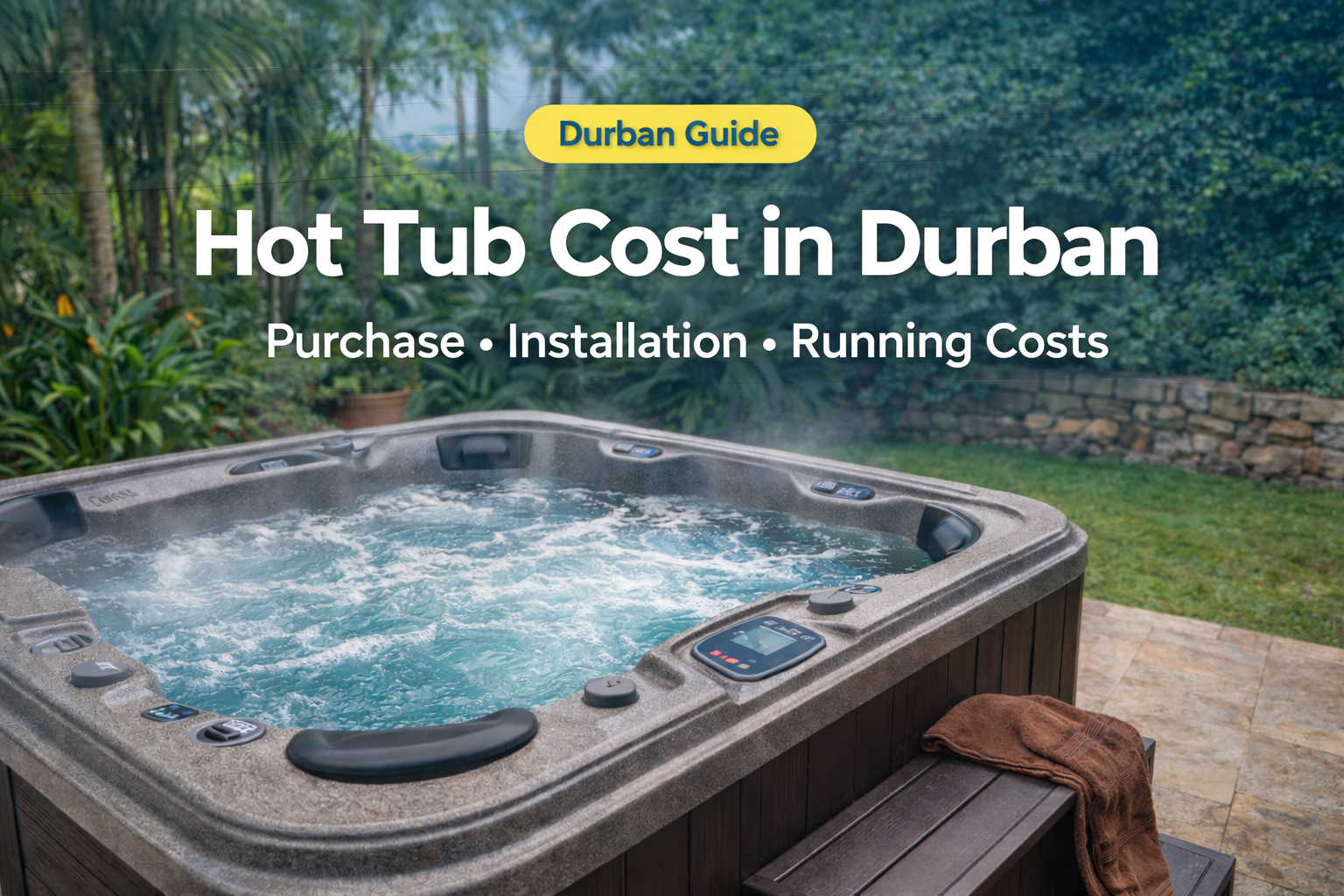
If you’ve been searching “Jacuzzi cost in Durban” or “hot tub prices Durban”, you’ve probably noticed the prices jump all over the place.
One ad shows a “spa” for under R20k, another quote is over R100k, and somewhere in the middle someone says, “Just budget for running costs too.”
They’re all telling the truth… they’re just talking about different types of hot tubs, with very different install requirements and electricity use.
So let’s make this simple and Durban-relevant: in this guide we’ll break your budget into the three buckets that matter most — purchase price, installation cost, and monthly running costs — and we’ll show you what pushes the number up (or keeps it sane) in Durban’s coastal climate.
Request a Custom Quote Today
Leave your details below and we’ll be in touch with a personalised quote.
The quick Durban answer: what most people pay (in real-world brackets)
In Durban, most homeowners fall into one of these brackets:
Inflatable / “bubble spa” style: usually the cheapest upfront, but can be expensive to run if insulation is weak. (You’ll see many options in the ±R13k–R24k range from mainstream listings.)
Entry-level rigid / rotational moulded tubs: you’ll see Durban suppliers quoting “from about R42k upwards” for basic rigid options.
Mid-range 4–6 seater “proper” hot tubs: common pricing signals are roughly R30k–R60k (depending on brand, jets, insulation, controls).
High-end built-in / luxury installs: can move into R100k–R200k+ territory (especially with premium finishes and electrical/site work).
Now let’s unpack why those brackets happen.
What makes Jacuzzi/hot tub costs jump in Durban?
Here’s the short list of “cost drivers” I see most often when people request a Jacuzzi installation in Durban:
Type of tub (inflatable vs rigid vs built-in)
Seating size & water volume (bigger volume = more heat + more chemicals)
Heating method & insulation quality (this controls your monthly bill)
Electrical requirements (dedicated circuit, isolator, sometimes upgrades)
Base/foundation work (slab, deck reinforcement, leveling, drainage)
Coastal exposure (humidity/salt air can mean you want better hardware and covers)
Your usage style (daily “always warm” vs weekend “heat up when needed”)
Keep those in mind as we go through the full breakdown.
Request a Custom Quote Today
Leave your details below and we’ll be in touch with a personalised quote.
1) Purchase cost in Durban: what you’re actually paying for
Inflatable / bubble spas (lowest purchase price)
These are popular because the upfront cost feels manageable, and they’re easy to place on a level surface.
You’ll see many bubble-spa style units commonly listed in the ±R13k–R24k region depending on size/features.
The trade-off: they’re often less insulated than rigid tubs, which can make running costs the real sting later (especially if you like hot water and you use it often).
Entry-level rigid tubs (Durban “from” pricing)
Some Durban-focused suppliers talk about basic rigid tubs starting from around R42,000+.
These generally feel sturdier than inflatables, often look better in a permanent outdoor setup, and can be more efficient depending on insulation and cover quality.
Mid-range hot tubs (the “sweet spot” for many homes)
A common national price bracket for mid-range stationary units is R30k–R60k, depending on brand and specs.
This is where you often start seeing better insulation, more reliable pumps, and controls that feel less “toy-like.”
High-end / built-in Jacuzzis
If you’re going for a true luxury “spa corner” with built-in finishes and premium features, it’s not unusual to see R100k–R200k+ price points.
At this level, the tub is only part of the spend — your site work and finishing (decking, pergola, privacy screens, electrical upgrades) becomes a big chunk of the total.
A quick note on “spa” vs “Jacuzzi”
People in Durban use hot tub, Jacuzzi, and spa interchangeably. When you’re comparing quotes, always confirm: are we quoting the tub supply only, or supply + installation, or a full built-in project?
2) Installation cost in Durban: what’s usually included
Here’s the part many people underestimate. Even if your tub is “portable,” it still needs a proper setup.
A common national reference point for installation (depending on site prep + electrical + plumbing needs) is roughly R5,000 to R20,000.
That range can be lower for a simple plug-and-play placement on a ready surface, and higher when you need electrical work, base work, or you’re doing a built-in surround.
The install items that change your quote the most
1) The base / foundation
In Durban, you want a base that stays level through rain and humidity. That usually means a proper slab, a well-built deck (rated for the load), or a prepared paved surface that won’t shift.
If you plan to place a tub on a deck, it’s worth taking weight seriously. Water is heavy — and a full tub can become a “structural project” fast.
2) Electrical work
Hot tubs draw real power. Many require a dedicated circuit, isolator, and correct protection. This is not the area to DIY or “make a plan.” Electrical scope is one of the main reasons quotes differ between installers.
3) Plumbing / drainage planning
Even if it’s not plumbed-in like a pool, you still need a sensible plan for:
how it fills
where it drains when you change water
how you avoid creating a soggy corner (Durban rain doesn’t forgive bad drainage)
4) Placement + coastal durability
Durban’s coastal air (especially nearer to the sea) can be rough on cheap exposed fittings over time. You’ll often get better longevity if you choose sensible placement (not directly in harsh spray zones), keep it covered, and don’t cheap out on the basics.
3) Running costs in Durban: electricity, chemicals, water, maintenance
This is the part that decides whether you love your hot tub… or resent it.
Electricity: the biggest monthly variable
A practical reference many SA sources share is that you might spend roughly R300–R1,000 per month to run a hot tub, depending on usage, electricity price, and efficiency.
Energy use itself is often described in a wide band too — for example, about 1.5 to 4 kWh per hour depending on the unit and conditions.
And factors that push consumption up include your target temperature, jet usage, and whether the water reheats during your session.
A Durban reality check: If you use the tub often, insulation and cover quality matter more than “how many jets” for your monthly bill. Durban is warm-ish compared to inland winters, but heat loss still happens at night, and humidity doesn’t magically keep water hot.
Chemicals and water treatment
You’ll need ongoing water care products (sanitisers, test strips, balancing chemicals). These costs vary by tub size and how strict you are about water quality, but they’re always part of ownership.
Water refills
Refill frequency depends on usage and maintenance habits. The better you manage water chemistry and filtration, the less often you’ll need to drain and refill.
Maintenance and repairs
In Durban, pumps and heaters are common repair topics over time (especially if the unit runs hard, or the tub is exposed). It’s one reason many people prefer buying from a supplier that also offers servicing/repairs locally.
Request a Custom Quote Today
Leave your details below and we’ll be in touch with a personalised quote.
How to cut running costs without killing the vibe
(Second and last bullet section — worth saving.)
Use a proper insulated cover and keep it on whenever you’re not using the tub (biggest win).
Drop the temperature slightly if you use it often (even a small drop helps).
Keep filters clean so the system doesn’t work harder than it should.
Don’t run jets longer than needed (jets are fun, but they add draw).
Add wind/privacy screening if your tub is exposed (less heat loss at night).
Choose better insulation at purchase time (a cheaper tub can cost more long-term).
If you’re a heavy user, consider heating solutions that reduce element dependence — some suppliers claim big savings with solar spa heating setups (just verify suitability and real-world expectations for your exact tub).
Request a Custom Quote Today
Leave your details below and we’ll be in touch with a personalised quote.
So… is a Jacuzzi/hot tub “worth it” in Durban?
If you’re the kind of person who will use it consistently (even 2–4 times a week), many homeowners feel it’s worth it — especially in Durban where outdoor living is part of the lifestyle.
But if you only want it “for December” and you’re not into ongoing water care, a hot tub can quickly feel like an expensive garden ornament. The best way to avoid regret is to choose the right type for your habits, and be realistic about electricity and maintenance.
Quick FAQs (Durban)
Is “Jacuzzi installation Durban” usually a one-day job?
For many above-ground setups on a ready base, yes — it can be quick. Some sources note portable installs can be done in a day or two, depending on type and site readiness.
Built-in surrounds and electrical upgrades can extend timelines.
What’s the biggest mistake people make?
Underestimating the running costs and buying a tub with poor insulation because the purchase price looked good.
Can I place a hot tub on decking?
Sometimes yes — but only if the deck is designed to carry the load. If you’re unsure, treat it like a structural question, not a decor choice.
Request a Custom Quote Today
Leave your details below and we’ll be in touch with a personalised quote.